

FRONT SHEET Individual Coursework
| ||
| CANDIDATE NUMBER (C-NUMBER) | ||
| MODULE NAME | Organisational Development | |
| WORD COUNT | 2454 | |
| SUBMISSION DATE | ||
DECLARATION I certify that this assessment submission is entirely my work and I have fully referenced and correctly cited the work of others, where required. I also confirm the contents of my submission have not been generated by a third party, or through an Artificial Intelligence generative system*. I have read the Student Discipline Regulations (Student Discipline Regulations) and understand any Assessment Related Offence/ Academic Misconduct may result penalties being applied. By submitting this assessment submission, I am confirming that I am fit to sit according to the Assessment Regulations.
I declare that:
Yes ☐ No ☐
Yes ☐ No ☐
Yes ☐ No ☐
*Please note that all the assignments are submitted to Turnitin. **Please note personal information (such as names) will be deleted. | ||
| ||
Organisational Development at BYD
A Responsible Global Localisation Initiative
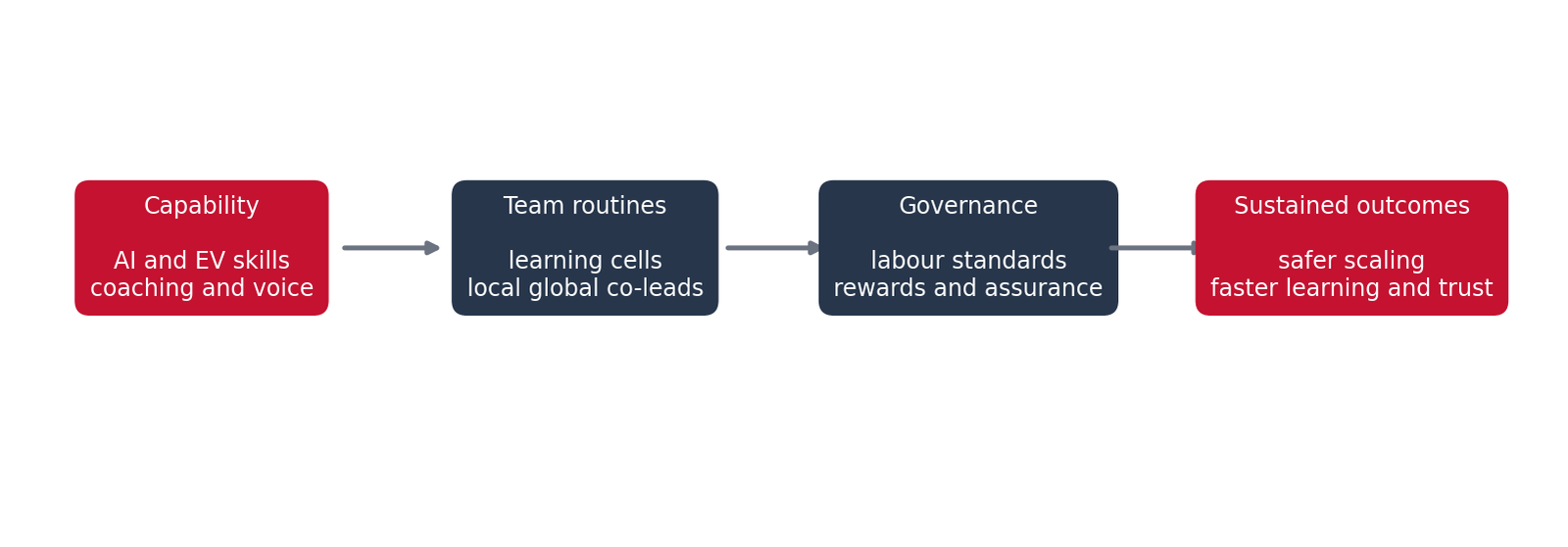
Table of Contents
1 Critical examination of OD foundations and process. 4
2 Modern changes in work and implications on BYD. 5
3 Multi level OD interventions that are evidence based. 7
4 Ability to maintain change in the long term.. 9
Evaluation and ownership matrix. 10
5 Critical reflection on employability development 10
Introduction
This report recommends Board advice to BYD on an organisational development activity of responsible global localisation. By developing a vertically converged technology regime at BYD, the company has created levels of scale and speed that have never been seen before, yet, export-based production, artificial intelligence-driven work and margin pressure imparts pressure on the people and system; the company will never be able to simply export the routines that enable work to run fast in China without altering them. The report insists that BYD needs to have a disciplined innovation and local capability, staff voice and enforceable labour governance. There is a participative action-research cycle relating diagnosis, multi-level interventions and sustained outcomes.
1 Critical examination of OD foundations and process
Organisation emerged as development was a reaction against the challenge of the Human Relations movement to an all-mechanistic kind of management, to field theory by Lewin, to group dynamics and action research, to T-group experiences of learning and to Tavistock socio-technical systems. Collectively these traditions converted the notion of change beyond the technical prescription to the participative, planned learning. The shortcomings of their promise of humanistic participation are that it can take the form of a consensual sense of participation and the concentration of power, and classical models of planned-change posit that there may be an end-state of stability in situations that digital competition can barely permit. Recent evidence views transformation therefore as not a technology installation, but as a communication between technologies, actors and organisational structures and communication (Hanelt et al., 2021; Nadkarni and Prugl, 2021). Discipline of BYD unfreeze-change-refreeze rationale of Lewin would be a good proposal, however, action research will be more suitable because of the short product development cycle and the different national institutions would require repetitive learning rather than one freezing.
OD unit of analysis also extended further and included team and open systems, other than interpersonal sensitivity. This is morally significant: the output in a situation when the risk, voice and opportunity are uneven in their distribution in the process cannot be used to determine the effectiveness of organisations. Instead, the socio-technical joint optimisation is better than technology-driven optimisation at BYD though it poses trade-offs with the launch speed.
The proposed cycle involves entry and contract with the Board, regional leaders, workers and contractors; mixed-method diagnosis skills, safety, culture and workflow, findings of feed backs; collaboratively designs and pilots’ interventions; process and business outcomes evaluation; and institutionalizes the effective routines in terms of policies, rewards and local ownership. Diagnosis can be reopened by feedback and it becomes a recursive cycle. This ensures the rigor of behavioral science and does not lead to the consultant dependency and linearity that are charged in swiftly evolving settings (Errida and Lotfi, 2021).
Figure 1 Recursive OD action research cycle proposed for BYD
Source Author-developed from the assessment guidance and action-research principles
2 Modern changes in work and implications on BYD.
Technology and work design. Competitive advantages of BYD gradually unite batteries, semiconductors, software, high-level manufacturing and AI-assisted development of vehicles. In research on digital transformation, it is found that the performance of the digital transformation relies on complementary changes in capabilities, rather than a sole tool per se (Trenerry et al., 2021). The automation of hazardous or repetitious work can be performed, however, it can also lead to deskilling of operators, monitoring increases, and isolation of engineers due to production knowledge. Evidence in automotive suggests that digitalization is a more secure alteration of occupational composition than abolition of work on a mass scale (Krzywdzinski, 2021). BYD thus requires role redesign that involves the use of algorithms that supplement judgement, operators to have the stop-work authority and the learning time preserved. Global engineering and commercial work can be effectively done by hybrid work, whereas remote work requires autonomy, social interaction and achievable workload; the transferability of hybrid work is not applicable in assembly jobs, which creates a fairness problem among occupational categories (Wang et al., 2021).
Conditions in the workforce and employment. The 2024 sustainability report of BYD documented 968,872 employees and 2025 reporting registered a 10.2% workforce reduction and revenue growth of 3.5% and 19.0-percent drop in profits (BYD Company Limited, 2025; Reuters, 2026). The comparison based on the indices below is warning of concurrent pressure on efficiency and fatigue with change. The fast recruitment of graduates and specialist labour increases the digital capacity, and access to development is uneven, resulting in a two-layered workforce. More so, a lawsuit filed by Brazilian prosecutors in 2025 alleged that contractor workers at BYD Camaçari construction site were subjected to human trafficking and other degrading conditions; BYD claimed to be cooperating and upholding relevant laws (Reuters, 2025a). This is an OD caution, in spite of ultimate responsibility: when there is no institutionalization of formal values, and where there is a contractor incentive, voice channels and assurance systems that allow local failure.
Globalisation- Production at the local level in Thailand, Brazil and Hungary minimizes tariff risks and paves way to customers; the Thailand facility was estimated to generate employment to 10,000 workers, whereas the Budapest hub is a bridge between R&D and university education (BYD, 2024, 2025). The localization, though, substitutes one problem of export by a coordination problem: global quality norms should co-exist with various other institutions of labour, linguistic differences, and various skill bases and demands of hierarchy. The green-and-digital turnover in automotive also results in unevenly distributed beneficial and adverse changes in regions (Cetrulo et al., 2026). The centralized speed of BYD may then break down in case local teams hide issues or the headquarters perceives cultural adaptation as resistance. Its strategic need is that of ambidexterity: a non-negotiable minimum in safety, morals and product quality, adjacency in local decision-making with learning, communications and work design.
Figure 2: Indexed indicators reveal growth alongside reduced organisational slack
| Shift | Opportunity | OD risk | Diagnostic evidence |
| AI and automation | Faster development; safer repetitive work | Deskilling, surveillance, workload | Task inventory; AI override and error data |
| Global localization | Tariff resilience; local market learning | Cultural silence; fragmented standards | Interviews by role/country; decision logs |
| Workforce pressure | Productivity focus; internal mobility | Fatigue, inequity, capability loss | Skills, wellbeing, attrition and workload |
| Contractor model | Flexible capacity | Rights and reputational failure | Worker voice; audits; remediation closure |
3 Multi level OD interventions that are evidence based.
These interventions are to act as a single 12-month Responsible Localisation Programme that may be piloted in Brazil and Hungary and likened with a full-scale Chinese plant. Action research helps to avoid hasty world-wide deployment: baseline statistics, interviewing of employees and contractors, process mapping and safety observations develop causal issues prior to scaling of solutions.
Individual level. Develop role-based AI, EV and intercultural pathsways to organizers, engineers, people managers and procurement employees. All the employees are provided with paid learning time, skills evaluation and a portable credential, managers are coached six-fold on inquiry, conversations about ethical escalation and change. Positive results are reported in the workplace-coaching meta-analysis, but it cautions that mechanisms and measures are mostly under-specified (Cannon-Bowers et al., 2023); BYD needs to pay per observable behaviour, rather than just per satisfaction. Skill demonstration, internal mobility, algorithm-override quality, wellbeing and retention, by country, gender, contract type and occupational group are the measures.
Team level. Form cross-functional socio-technical learning groups of operators, software engineers, quality, HR, procurement and contractors’ representatives. A biweekly review of near misses, AI mistakes, work and localisation challenges; local and Chinese co-leads switch facilitation and lead a bilingual decision registry. Psychological safety facilitates error reporting and learning, but does not include comfort or decreased accountability (Edmondson and Bransby, 2023; Jager and Link, 2026). Teams stay no blame reporting and have explicit corrective ownership. This requires stable learning conditions, reflexivity and boundary-span as team-learning behaviour can sometimes reduce following the launch (Widmann and Mulder, 2025). Next, communities of practice move confirmed improvement across plants, and acknowledge the fact that such communities are also capable of safeguarding expert power and sidelining peripheral employees (Nicolini et al., 2022).
Organisational level. Install a Responsible Localisation Operating System: global minimum standards of labour and safety; lines of grievance accessible to workers that are not dependent on-line management; contractor due diligence, unannounced audit and remediation; regional OD councils that include employees, and a balanced executive scorecard with bonuses quantifiably linked to quality, skills, safety, voice closure and delivery. Parker and Grote (2022) suggest that digital work design should not eliminate human agency, and new AI systems need to be assessed on their impact on workers prior to implementation.
Implementation ought to be gradual. Months 0-2 contract and diagnose; months 3-5 co-design and pilot two learning cells at each site, month 6 make a continue, adapt or stop decision, months 7-12 scale only those components that pass safety, learning and operating criteria. A budget and authority are assigned to a named regional change lead and an outside facilitator removed once the capability is transferred. This sequencing will strike the right balance in the urgency of BYD and the evidence: Standardisation does not come before local testing.
Figure 3 Multi-level intervention logic
Source: Author-developed. Arrows indicate necessary contribution links, not guaranteed causality
4 Ability to maintain change in the long term
It is more than a chance that the programme would maintain change, although only through a mutually reinforcing mechanism. Self-efficacy and mobility may be enhanced by individual training, but practice may be eliminated by production pressures or experimentation by the boss. Self-report inflation is also susceptible to coaching. Its contribution in the long term is thus contingent on in-verified competencies, reconfigured job sets and promotion standards. The teams learning cells are able to detect weak signals prior to safety or quality breakages and convert worldwide knowledge at the local level. But power distance, linguistic and time constraint can drown out a voice of contractor or operator.
The best institutionalization mechanism is thought to be provided by organisation-level governance as it alters incentives and contractor controls. Its failure lies in ritual conformity: audits are subject to gaming and international standards can push domestic experience off. The repeated readiness assessments are necessary due to the dynamic nature of readiness where it is not predictable by a single baseline assessment (Caci et al., 2025). The reactions of employees should also be regarded as the diagnostic evidence and not as irrational resistance, systematic review indicates that reactions have cognitive and behavioural origins on an individual and organisational level (Khaw et al., 2023). Regional councils must thus be given the mandate to implement adaptive mandate and the Board to safeguard non-negotiable rights.
The determining counterforces are power and time. A consultation theatre is a council with no decision rights; a scorecard with too many indicators can invite selective reporting; and a successful pilot can fail because upon relocation to a more voluminous plant. These risks are minimized through independent worker access, public definition, sample-based verification and a well-defined path of escalation.
An assessment will be made based on a contribution logic, but will not make a claim of a simple cause and effect. BYD ought to measure processes leading to outcomes at baseline and months 3, 6 and 12: learning hours completed, psychological safety, audit action closure and cross-functional participation, as well as outcomes: defects per vehicle, severity of near-misses, regretted attrition, internal-fill rate, vendor breaches and adherence to product-cycle at month 6. The programme effects are differentiated by matched-plant comparisons and qualitative follow-ups, as compared to demand or regulatory shocks. Adaptation occurs in response to thresholds: e.g., constant voice with falling incidents can be an indication of under-reporting. To be sustainable necessitates three factors: transparent Board consistency where targets are inconsistent with safety; safeguarded resources in times of margin pressure; and relocation of ownership to trained regional departments.
Evaluation and ownership matrix
| Level | Leading indicator | Outcome indicator | Owner |
| Individual | Verified learning and coaching behaviour | Mobility, retention, safe AI judgement | Regional HR |
| Team | Voice, participation and action closure | Defects, near-miss severity, cycle adherence | Plant leader |
| Organisation | Audit remediation and reward alignment | Contractor breaches, trust, quality | Board committee |
5 Critical reflections on employability development
What- The data-gathering exercise of TLG Solutions consulting turned my perception of consultancy. My desire was first to make a diagnosis based on the most conspicuous symptoms. A comparison of interview, observation and organisational evidence revealed that when the confidence of advice to solve the wrong problem rests on one source it will take the wrong problem. My resistant response to the pull to be the expert, which is a skill of the Unit 5 role play, is also evident in the way I tend to say yes when the group felt they needed to know and I say no, ask questions that would help them own the clients.
So, what- These experiences reinforced two education benefits, intellectual and academic mastery, and interaction and cooperation. I am now able to discard evidence, inference and suggestion, criticize an attractive explanation, and relate an individual behaviour to team and system conditions. More so, I got to know that facilitation is not not being passive. Diagnostic question: This is a judgment skill to ask a specific diagnostic question, to listen to what is not said, and/or to provide the returned data without embarrassing the participants. The fact that I feel uncomfortable being quiet tells of one practical development need: when pressed, I might be more inclined to prioritize speed over involvement - the same pitfall I recognized kind of problem in the BYD analysis.
Now what- I will practice with a short contracting checklist with purpose, stakeholders, confidentiality, authority and success measures, in future project/ people-management work. I will have at least three different types of evidence to triangulate and note down different possible explanations before advising on action. During the meetings I will include stopping, calling on the least-heard opinion and summarizing disagreement before I present my opinion. After every project, I will also consult about this behaviour and maintain a reflective journal. Such efforts make the learning benefits of the module educative outcomes become practical consultative, research and collaborative leadership.
Conclusion
BYD does not require slowness in innovating; it requires organisational capability to make speed safer and transferable. Participation is a contribution of classical OD, as well as socio-technical alignment and disciplined diagnosis, however action research is more relevant to ongoing technological and geopolitical change than linear refreeze. The multiplied programme suggested is related to accredited capability and coaches, cross-functional learning cell, and enforceable global labour governance. And its strength comes in the connections: without role and reward change training will be evacuated; without team voice and protection it will be muffled; without local ownership audits will become rituals. Cross-plant piloting, learning on gate 3-, 6-, and 12-month, and handing over ownership to regional teams provides BYD a plausible path to thoughtful localisation and long-term change.
References
BYD Company Limited. (2025). 2024 sustainability report. https://www.bydauto.co.nz/storage/uploads/e8621d3d-1f8a-4848-b1d4-c0e5d60d9c53/BYD-Sustainability-Report-2025.pdf
BYD. (2024, July 4). BYD Thailand factory inauguration and roll-off of its 8 millionth new energy vehicle. https://www.bydglobal.com/en/news/2024-07-04/BYD-Thailand-Factory-Inauguration-and-Roll-off-of-Its-8-Millionth-New-Energy-Vehicle
BYD. (2025). BYD commits to new HQ and R&D base in Hungary. https://www.byd.com/eu/news-list/BYD_commits_to_new_HQ_and_RD_base_in_Hungary
Caci, L., Nyantakyi, E., Blum, K., Sonpar, A., Schultes, M.-T., Albers, B., & Clack, L. (2025). Organizational readiness for change: A systematic review of the healthcare literature. Implementation Research and Practice, 6. https://doi.org/10.1177/26334895251334536
Cannon-Bowers, J. A., Bowers, C. A., Carlson, C. E., Doherty, S. L., Evans, J., & Hall, J. (2023). Workplace coaching: A meta-analysis and recommendations for advancing the science of coaching. Frontiers in Psychology, 14, 1204166. https://doi.org/10.3389/fpsyg.2023.1204166
Cetrulo, A., Dosi, G., Moro, A., Nelli, L., & Virgillito, M. E. (2026). Automation, digitalisation and decarbonisation in the European automotive industry: A roadmap towards a just transition. Review of Evolutionary Political Economy, 7, Article 20. https://doi.org/10.1007/s43253-026-00178-4
Edmondson, A. C., & Bransby, D. P. (2023). Psychological safety comes of age: Observed themes in an established literature. Annual Review of Organizational Psychology and Organizational Behavior, 10, 55–78. https://doi.org/10.1146/annurev-orgpsych-120920-055217
Errida, A., & Lotfi, B. (2021). The determinants of organizational change management success: Literature review and case study. International Journal of Engineering Business Management, 13. https://doi.org/10.1177/18479790211016273
Hanelt, A., Bohnsack, R., Marz, D., & Antunes Marante, C. (2021). A systematic review of the literature on digital transformation: Insights and implications for strategy and organizational change. Journal of Management Studies, 58(5), 1159–1197. https://doi.org/10.1111/joms.12639
Jäger, B. B., & Link, K. (2026). Psychologische Sicherheit als Ressource für lernende Organisationen – eine konzeptionelle Perspektive zur Begleitung von Transformationsprozessen [Psychological safety as a resource for learning organisations]. Gruppe. Interaktion. Organisation. https://doi.org/10.1007/s11612-026-00902-y
Khaw, K.W., Alnoor, A., Abrrow, H.A., Tiberius, V., Ganesan, Y. and Atshan, N.A. (2022). Reactions towards organizational change: A systematic literature review. Current Psychology, [online] 42(42). doi: https://doi.org/10.1007/s12144-022-03070-6
Krzywdzinski, M. (2021). Automation, digitalization, and changes in occupational structures in the automobile industry in Germany, Japan, and the United States. Industrial and Corporate Change, 30(3), 499–535. https://www.econstor.eu/handle/10419/228480
Nadkarni, S., & Prügl, R. (2021). Digital transformation: A review, synthesis and opportunities for future research. Management Review Quarterly, 71, 233–341. https://doi.org/10.1007/s11301-020-00185-7
Nicolini, D., Pyrko, I., Omidvar, O., & Spanellis, A. (2022). Understanding communities of practice: Taking stock and moving forward. Academy of Management Annals, 16(2), 680–718. https://doi.org/10.5465/annals.2020.0330
Parker, S. K., & Grote, G. (2022). Automation, algorithms, and beyond: Why work design matters more than ever in a digital world. Applied Psychology, 71(4), 1171–1204. https://doi.org/10.1111/apps.12241
Reuters. (2025a, May 27). Brazil prosecutors sue Chinese carmaker BYD for violating labor rights. https://www.reuters.com/sustainability/society-equity/brazil-prosecutors-sue-byd-violating-labor-rights-2025-05-27/
Reuters. (2026, March 27). BYD’s annual profit drops for first time in four years as price war hurts margins. https://www.reuters.com/world/asia-pacific/chinese-ev-maker-byd-posts-first-annual-profit-decline-four-years-2026-03-27/
Trenerry, B., Chng, S., Wang, Y., Suhaila, Z. S., Lim, S. S., Lu, H. Y., & Oh, P. H. (2021). Preparing workplaces for digital transformation: An integrative review and framework of multi-level factors. Frontiers in Psychology, 12, 620766. https://doi.org/10.3389/fpsyg.2021.620766
Wang, B., Liu, Y., Qian, J., & Parker, S. K. (2021). Achieving effective remote working during the COVID-19 pandemic: A work design perspective. Applied Psychology, 70(1), 16–59. https://doi.org/10.1111/apps.12290
Widmann, A., & Mulder, R. H. (2025). Change in team learning behaviours in work teams: A systematic review. Educational Research Review, 49, 100736. https://doi.org/10.1016/j.edurev.2025.100736