

EDUC6009 Assessment 1: Critical Review of Resources Guide [2026]
If you are studying EDUC6009 – Education and Indigenous Australians: Ways of Knowing and Being at Southern Cross University (SCU), Assessment 1 asks you to do more than simply describe three Aboriginal and Torres Strait Islander education resources.
You need to select three appropriate resources, explain how they could be used in a classroom, and critically evaluate their educational value and cultural appropriateness.
The assessment is worth 50%, has a length of 1,500 words or equivalent, and is an individual assessment. The brief requires three resources relevant to teaching Aboriginal and Torres Strait Islander histories, cultures and languages, with consideration of the land or Country on which the student is located.
Quick answer: For EDUC6009 Assessment 1, select three culturally appropriate education resources, identify their format, age/stage and learning area, explain how and why you would use each resource, and critically evaluate each resource for educational value and cultural appropriateness using the AIATSIS Guide.
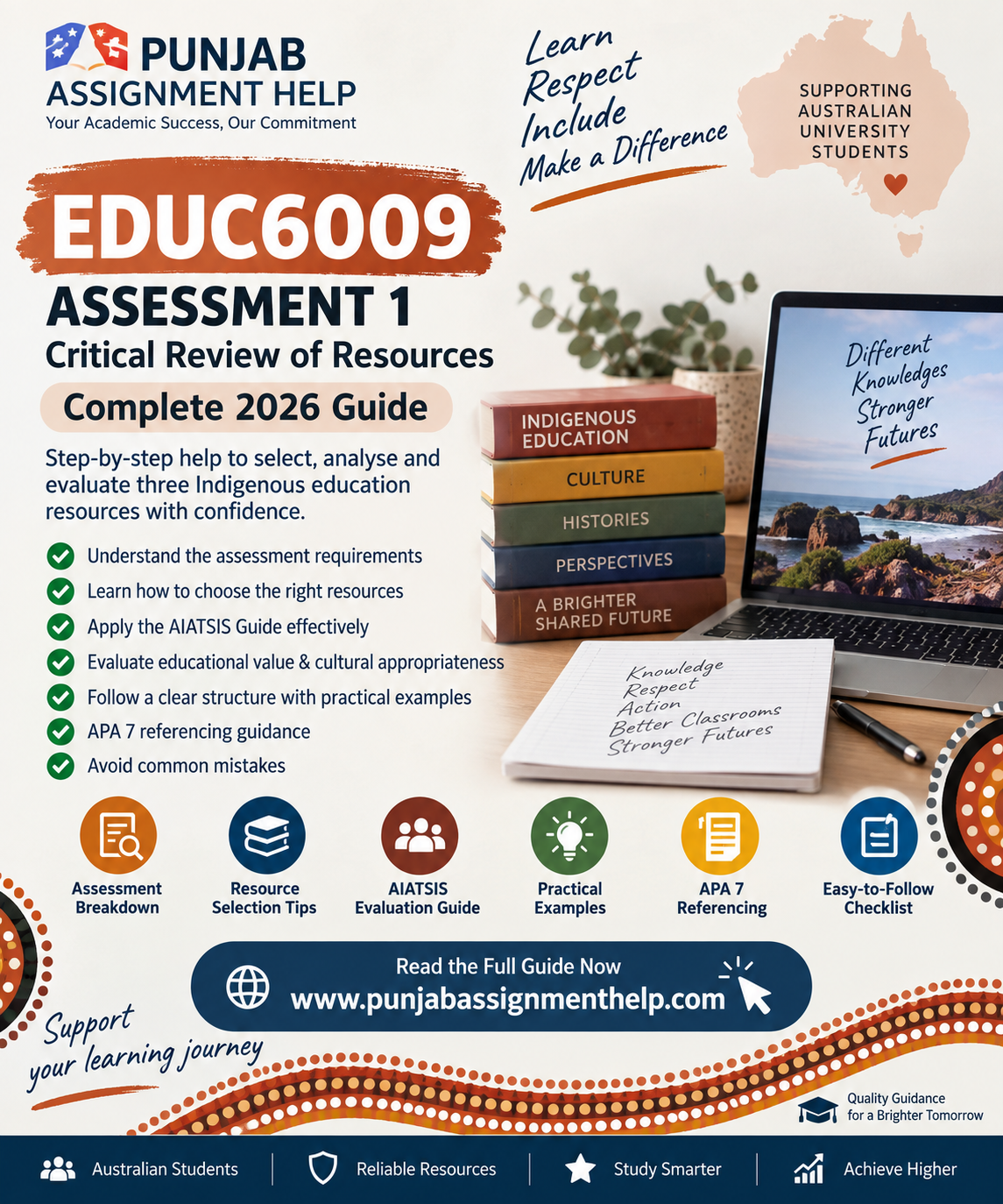
What exactly do you have to do?
The official assessment brief identifies the task as Critical Review of Resources.
The key requirements are:
| Requirement | Details |
| Unit | EDUC6009 |
| Unit title | Education and Indigenous Australians: Ways of Knowing and Being |
| Assessment | Assessment 1 |
| Assessment type | Critical Review of Resources |
| Weighting | 50% |
| Length | 1,500 words or equivalent |
| Submission | Individual |
| Resources required | 3 |
| Main evaluation areas | Educational Value and Cultural Appropriateness |
| Evaluation framework | AIATSIS Guide to evaluating and selecting education resources |
| Submission system | Turnitin |
| File format | One Microsoft Word document |
What is EDUC6009 Assessment 1 actually asking?
The task can be understood as a three-stage process:
1. Select three resources
You need three resources that can be used for teaching Aboriginal and Torres Strait Islander curriculum content.
- Aboriginal histories
- Aboriginal cultures
- Torres Strait Islander histories
- Torres Strait Islander cultures
- Indigenous languages
- Appropriate classroom teaching and learning
The brief also states that resources should be culturally relevant to the land or Country you are on.
2. Explain how each resource could be used
For each resource, explain what it is, its format, appropriate age/stage, learning area, classroom use and rationale.
3. Critically evaluate the resource
Each resource needs to be evaluated for educational value and cultural appropriateness. The assessment specifically directs students to the AIATSIS Guide to evaluating and selecting education resources.
How many resources do you need?
You need three resources. Do not select them simply because they are easy to find. A strong selection should give you enough evidence to discuss educational usefulness, cultural authority, Indigenous perspectives, relevance to local Country, classroom suitability, age appropriateness, curriculum relevance, strengths, limitations and cultural sensitivities.
What types of resources can you choose?
The assessment brief provides examples including:
- Paintings
- Artefacts
- Books
- Websites
- Games
You should not assume that every resource mentioning Aboriginal or Torres Strait Islander people is automatically appropriate. A resource can be educationally interesting but still be unsuitable because of inaccurate representation, stereotyping, lack of Indigenous perspectives, inappropriate generalisation, lack of cultural authority, weak connection to Country, outdated information or inappropriate classroom use.
Important: Two things you cannot use as your resource
The assessment brief explicitly states that the following cannot be used as resources:
- 8 Ways of Learning
- Cross-curriculum priorities as a resource
The Australian Curriculum cross-curriculum priority may be relevant as curriculum context, but the brief specifically says it cannot itself be selected as one of the three resources.
How to choose the three resources
Is it genuinely an education resource? Can a teacher actually use it to support classroom learning?
Who created it? Identify the author, artist, organisation, Indigenous community, cultural authority, publisher or institution.
Whose knowledge is represented? Avoid treating Aboriginal and Torres Strait Islander cultures as one single, uniform culture.
Where does the resource come from? Ask whether it has a meaningful connection to the student's local Country.
Is it appropriate for the intended age group? A resource suitable for university students may not be suitable for primary-school children.
Can you evaluate it critically? Choose resources that provide enough evidence to discuss both strengths and limitations.
What does resource description mean?
For each resource, provide enough information for the reader to understand exactly what you are evaluating. The assessment specifically asks you to describe the resource's format, age/stage group and learning area.
Resource 1 – Planning Template
Title: [Insert your research and analysis here]
Creator/organisation: [Insert your research and analysis here]
Format: [Insert your research and analysis here]
Age/stage: [Insert your research and analysis here]
Learning area: [Insert your research and analysis here]
Content: [Insert your research and analysis here]
Classroom use: [Insert your research and analysis here]
Rationale: [Insert your research and analysis here]
Then move from description into critical evaluation.
How to evaluate educational value
Educational value accounts for 30% of the assessment rubric. Do not spend your entire section describing what the resource contains.
Ask: Does the resource actually help students learn?
- What knowledge does it develop?
- What skills does it develop?
- Does it support curriculum objectives?
- Is it understandable for the intended age group?
- Does it encourage inquiry?
- Does it promote critical thinking?
- Is it engaging?
- Can it support classroom discussion?
- Does it provide authentic perspectives?
- Does it help students develop understanding rather than simply memorise information?
Example of weak evaluation
This website is useful because it provides information about Aboriginal culture.
A stronger analytical approach
Instead of simply stating that a resource is useful, examine why it is educationally effective, for whom, and under what classroom conditions.
For example: The resource may support inquiry-based learning because students can examine the information, identify the perspective presented and connect it to a specific curriculum question. However, its educational effectiveness depends on whether the teacher provides sufficient context and avoids presenting the resource as representative of Aboriginal and Torres Strait Islander cultures generally.
How to evaluate cultural appropriateness
Cultural appropriateness is worth another 30% of the assessment rubric.
For each resource, investigate:
- Who created the resource?
- Whose Aboriginal or Torres Strait Islander knowledge does it represent?
- Is the creator Indigenous?
- Which community or Country does the content relate to?
- Is the information appropriately contextualised?
- Does it respect Indigenous perspectives?
- Does it avoid stereotypes?
- Does it avoid presenting Indigenous cultures as one homogeneous culture?
- Does it acknowledge Country or community appropriately?
- Are there cultural sensitivities associated with the content?
- Is it appropriate for the student's particular Country?
- Does it accurately represent Aboriginal and Torres Strait Islander perspectives?
The AIATSIS approach: what should you look for?
- Aboriginal and Torres Strait Islander authorship – Who produced the resource? Does it recognise Indigenous authorship or authority where appropriate?
- Indigenous perspectives – Does it actually include Aboriginal or Torres Strait Islander perspectives?
- Cultural authority – Does the creator or organisation have an appropriate relationship with the knowledge presented?
- Country and community – Does it identify the relevant Country, community or people?
- Accuracy – Is the information historically and culturally accurate?
- Stereotypes – Does it unintentionally reinforce stereotypes?
- Diversity – Does it acknowledge the diversity of Aboriginal and Torres Strait Islander peoples?
- Cultural sensitivity – Does it contain material requiring additional care, context or warnings?
- Classroom context – How should a teacher introduce and contextualise it?
- Potential harm – Could careless use result in misunderstanding, stereotyping or cultural harm?
Why cultural appropriateness is more than being respectful
A common mistake is to write: 'This resource is culturally appropriate because it is respectful.' That is not enough for a critical review.
Instead, investigate how and why the resource is culturally appropriate.
- Who speaks?
- Whose knowledge is included?
- Whose knowledge is missing?
- Who created the resource?
- Which Country or community does it relate to?
- Is cultural authority evident?
- Could the material be misunderstood outside its original context?
- What would a teacher need to explain before using it?
This transforms a descriptive statement into a critical evaluation.
Local Country matters in EDUC6009
The brief states that resources should be culturally relevant to the land or Country the student is on.
Students should therefore avoid choosing resources simply because they appear high in Google results. Investigate resources connected to the Aboriginal or Torres Strait Islander peoples and Country associated with the student's study location.
Southern Cross University's 2026 EDUC6009 unit is offered across locations including Coffs Harbour, Gold Coast, Lismore, Melbourne, Perth and Sydney, as well as online, so the appropriate local context can differ between students.
Never invent an Indigenous Country name simply to satisfy the assignment.
EDUC6009 Assessment 1: Recommended structure
A 1,500-word critical review needs careful word management. A practical structure is:
| Section | Suggested allocation |
| Introduction | 100–150 words |
| Resource 1 | 350–400 words |
| Resource 2 | 350–400 words |
| Resource 3 | 350–400 words |
| Conclusion | 100–150 words |
| Total | Approximately 1,500 words |
Recommended structure for each resource
- Resource description – What is it? Who created it? What format is it?
- Age/stage and learning area – Who is it designed for? Which curriculum area does it support?
- Classroom application – How could a teacher use it? What would students do? What learning could result?
- Educational value – What are its strengths? What are its limitations? How effective is it?
- Cultural appropriateness – Who created it? Whose perspectives are represented? How does it relate to Country? What risks or limitations need to be recognised?
- Overall judgement – Would you recommend using it? Under what conditions?
What does critical review actually mean?
A description tells the reader what something is. An evaluation tells the reader how good or appropriate it is. A critical review goes further by examining both strengths and limitations and making a reasoned judgement.
Descriptive
The resource is a website containing information about Aboriginal history.
Evaluative
The website provides accessible historical information suitable for classroom introduction.
Critical
Although the website provides accessible historical information and could support introductory classroom learning, its usefulness depends on how the teacher contextualises the material. The resource should be examined for authorship, community authority and the specificity of the Country and perspectives represented before being presented as an authoritative account of Aboriginal history.
A simple framework for critical analysis
CLAIM – What are you claiming about the resource?
EVIDENCE – What evidence supports your claim?
ANALYSIS – Why does that evidence matter?
LIMITATION – What limitation or risk should be acknowledged?
JUDGEMENT – What is your overall evaluation?
EDUC6009 Assessment 1 and APA 7
The assessment requires APA 7th referencing.
- In-text citations
- Complete reference list
- Consistent author/date information
- Correct formatting of online resources
- Accurate URLs or DOIs where applicable
- Citations for factual claims
- Citations for research supporting your evaluation
Useful source hierarchy
- Indigenous-authored or Indigenous-controlled sources where appropriate
- AIATSIS
- Australian government sources
- Official education bodies
- Original resource creators
- Peer-reviewed research
- University sources
- Reputable educational organisations
Avoid relying heavily on random blogs, unsourced websites, generic assignment websites, Wikipedia as a primary source, or social media posts without authoritative context.
The official AIATSIS resource should be central to your research
The AIATSIS Guide is particularly important because it is explicitly named in the assessment instructions. Use it as a basis for critical reflection and informed resource selection.
Official AIATSIS Guide: https://aiatsis.gov.au/education/guide-evaluating-and-selecting-education-resources
What students should NOT do
Selecting the first three Google results: Search ranking does not prove cultural appropriateness.
Describing instead of evaluating: A resource description is only one part of the task.
Treating Aboriginal cultures as one culture: Australia has many Aboriginal and Torres Strait Islander peoples, communities, Countries, languages and knowledge traditions.
Ignoring authorship: Always investigate who created the resource.
Ignoring local Country: The assessment requires consideration of the Country on which the student is located.
Calling something culturally appropriate without evidence: Explain why.
Using prohibited resources: Do not use 8 Ways of Learning or Cross-curriculum priorities as a resource.
Spending all 1,500 words on description: Educational value and cultural appropriateness each carry 30%.
Ignoring limitations: Critical evaluation requires balanced judgement.
Using AI to generate the assessment: EDUC6009 has specific GenAI restrictions.
EDUC6009 Assessment 1 checklist
Resource selection
☐ Selected exactly three resources
☐ Resources are relevant to Aboriginal and Torres Strait Islander education
☐ Resources are appropriate for the local Country/context
☐ Prohibited resource types have been avoided
☐ Creator/organisation has been identified
Resource description
☐ Format explained
☐ Age/stage identified
☐ Learning area identified
☐ Resource content explained
Classroom application
☐ Explained how the teacher could use each resource
☐ Explained why it would be used
☐ Connected the resource to educational goals
Educational value
☐ Effectiveness evaluated
☐ Strengths identified
☐ Limitations identified
☐ Age appropriateness considered
☐ Student learning considered
Cultural appropriateness
☐ Perspectives considered
☐ Authorship investigated
☐ Cultural authority considered
☐ Country/community considered
☐ Stereotypes or inaccurate representation checked
☐ AIATSIS Guide applied
Academic writing
☐ APA 7 used consistently
☐ In-text citations included
☐ Reference list included
☐ Word count checked
☐ Academic sources used
☐ One Word document prepared
☐ Correct file naming used
☐ GenAI declaration included where required
EDUC6009 GenAI declaration: don't overlook this
The assessment brief requires a GenAI declaration. If GenAI was knowingly used for permitted purposes, the declaration needs to explain which tool was used, what it was used for, and how the output was used. The brief provides an example declaration and states that the declaration does not count toward the assessment word limit.
If GenAI was not used, the brief also provides a declaration students can include.
Always follow the current assessment brief and Unit Assessor's instructions rather than assuming that a generic university AI policy applies.
Frequently Asked Questions
What is EDUC6009 Assessment 1?
It is a Critical Review of Resources for Southern Cross University's Education and Indigenous Australians: Ways of Knowing and Being unit. Students select and critically evaluate three resources for teaching Aboriginal and Torres Strait Islander curriculum content.
How many resources are required?
Three resources are required. Each needs to be described, justified and critically evaluated.
How many words is EDUC6009 Assessment 1?
The assessment length is 1,500 words or equivalent.
What is it worth?
It is worth 50% of the unit assessment.
What framework should be used?
The assessment specifically directs students to the AIATSIS Guide to evaluating and selecting education resources.
What are the main marking criteria?
Resource Selection and Application 30%; Cultural Appropriateness 30%; Educational Value 30%; Academic Writing 10%.
Can I use 8 Ways of Learning?
No. The assessment brief explicitly identifies 8 Ways of Learning as a source that cannot be used as a resource.
Can I use the Australian Curriculum cross-curriculum priority as a resource?
No. The brief specifically states that Cross-curriculum priorities as a resource cannot be used.
Do the resources need to relate to my local Country?
Yes. The assessment brief states that resources should be culturally relevant to the land or Country you are on.
Does it require APA 7?
Yes. The brief specifies APA 7th referencing.
Can I use ChatGPT to write my assignment?
The brief permits specified uses such as editing for clarity, grammar and sentence structure but does not permit GenAI to produce the intellectual substance of the assessment or generate, rewrite or paraphrase the assignment.
Final advice for EDUC6009 Assessment 1
Don't ask only: Is this a good resource?
Instead ask: Is this an educationally effective, culturally appropriate and contextually relevant resource for teaching this particular group of students, and what evidence supports my judgement?
That shift from description to evaluation to critical judgement is what can move the work toward the higher rubric bands.
For the strongest preparation, start with the official AIATSIS Guide, investigate the provenance and cultural context of each proposed resource, establish its relevance to the student's Country, and then evaluate its classroom usefulness rather than simply summarising what the resource contains.
Recommended official sources
- Southern Cross University – EDUC6009 2026: https://www.scu.edu.au/study/units/educ6009/2026/
- AIATSIS – Guide to evaluating and selecting education resources: https://aiatsis.gov.au/education/guide-evaluating-and-selecting-education-resources
Suggested Internal Links for Punjab Assignment Help
Where relevant pages exist on your website, add contextual internal links to:
- SCU Assignment Help
- EDUC6009 Assignment Help
- Australian University Assignment Help
- Education Assignment Help
- Indigenous Education Assignment Help
- APA 7 Assignment Help
- Academic Writing Help
Use descriptive anchor text naturally within relevant paragraphs rather than adding a large block of repetitive links.